During the Pandemic, I’ve been fortunate to receive photos from family and friends who live in different locations. They contribute to the blog and add interest. This is a collaborative effort by neighbors in Massachusetts.
I received a photo of an owl sitting on a snow covered wall from my longtime friend Linda Dempster.
Photo by Linda Dempster
Later Linda sent me another photo of the owl who’d flown up in a tree. She’d received it from her neighbor. I asked her to ask the neighbor if they’d consent to the owl in the tree photo being posted on the blog. So thank you Linda and neighbor Anne Laibe Bertalino for the interesting owl photos and being the guest bloggers today.
Perfectly framed by the branches. Photo by Anne Laibe Bertalino.Look at those owl eyes! Wonderful capture, Anne.
In 2012 my most popular post was from guest blogger Shuey in Florida with his barred owl photo.
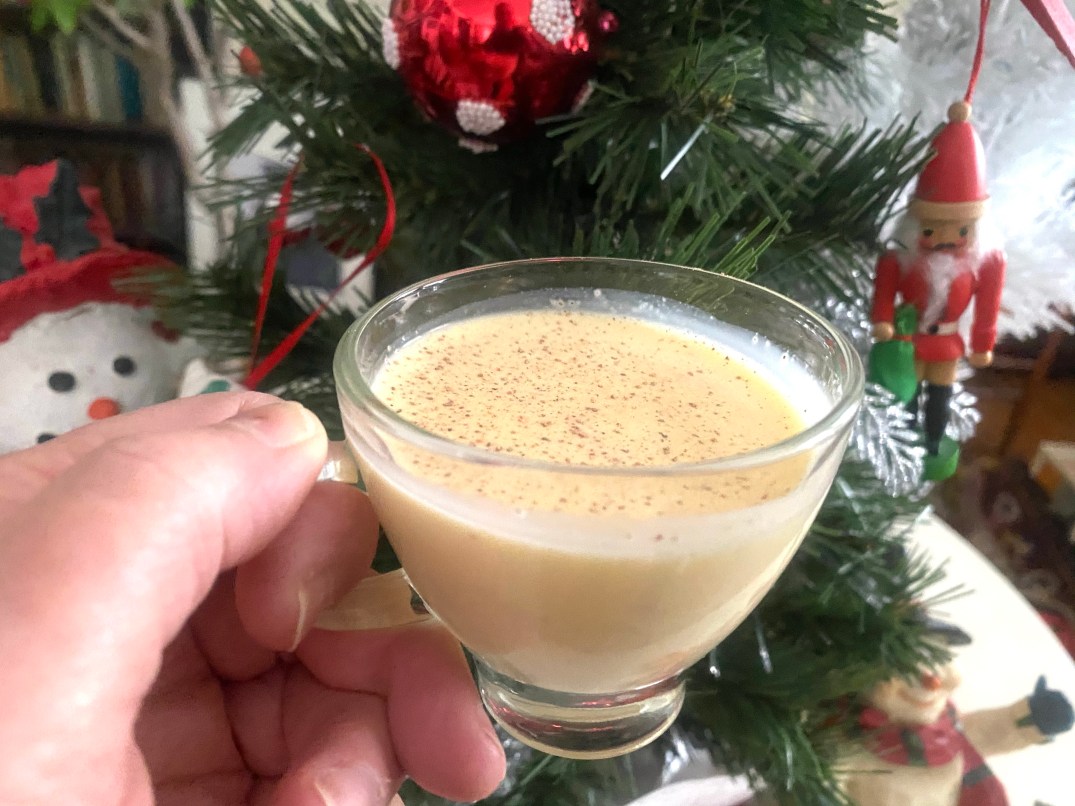
Eggnog, egg nog or egg-nog, historically also known as milk punch or egg milk punch, is a rich, chilled, sweetened, dairy-based beverage. It is traditionally made with milk, cream, sugar, whipped egg whites, and egg yolks.” Wikipedia
And if yes, spiked or non-alcoholic? And if spiked, what alcohol do you add? Rum, bourbon, whiskey?
A rich and creamy adult milkshake it was called in one recipe I read. I think it’s a love it or hate it but we’ll see what response we get.
My mother made it with raw eggs when I was a kid and sprinkled nutmeg on top. She used a hand held egg beater, a rotary one, non-electric, to whip the egg whites into froth. There was no cooking involved that I remember but there is definitely cooking in Alton Brown’s recipe.
“At my Writerly Desk with tea and biscuits” Karen Hough*
I’m Canadian, currently living in London with my husband and 3 kids. My blog is Dammit Karen and my website is Karen Hough Writes My author name is “K.A. Hough.” My book is called Ground Control”
Writing by Discovery
In writing, there are plotters – people that plot out their stories and follow that plan – and there are pantsters, which are kindly called “discovery writers.” This pantster signed up for National Novel Writing Month 2019 (NaNoWriMo).
I had an idea, a “what if,” and I had a deadline. Every night that November, after the kids went to bed, I followed my characters around for approximately 1800 words. Some nights it took an hour to meet my wordcount; some nights it took four. It was stressful, and I was tired, but it was only 30 days. I tried not to think about it during the day.
As a “discovery writer,” I honestly had no idea what was ever going to happen next. As I typed, I’d suddenly realize something about a character’s past. Or I’d leave a note to myself in all caps that said, “HOW LONG TO GET TO MARS?” – because now they were going to Mars (unplanned by me, but that’s where they were going, so I should probably find out more about it if I was really going to write this ridiculous book). I did research as I went, and kept a spreadsheet of links to NASA, MarsONE and studies about soil bacteria, which had – also against my will – become an issue on the space shuttle, and one that I couldn’t fix for months. I wasn’t in control.
The story went off in weird tangents – not my story, because my story was never supposed to be about space and soil – it twisted and turned. I wrote completely without a plan, without an ending in mind, and somehow, I managed to type my last word – my 50,083rd – just before midnight on November 30th.
It wasn’t the story I had planned to write, and they weren’t perfect words but there were 50,000 of them. I put it away for a month, then read it with fresh eyes, and while it was still imperfect, it wasn’t terrible. Over the next six months, in lockdown, I revised, expanded and rewrote while my kids sat and homeschooled beside me.
NaNoWriMo was a grind, but it gave me the reasonably short timeframe and the motivation I needed to finally write a novel. I even sat down to do it again this year. I wrote another 50K words in 30 days, but this time I was prepared. I wasn’t a pantster this time: I had an outline, almost chapter-by-chapter, of what I wanted to happen and what I wanted to develop. This story wasn’t going to go rogue on me (though it did, here and there), but I discovered something else: it wasn’t as much fun.
Ground Control is being published in e-book, paperback and hardcover formats in the Spring
Thinking about laundry and washday which was traditionally on Mondays-click for history
Do you have a specific day for laundry?
A fellow knitter hailing from Maine responded to my post of Fels-Naptha Soap
Here is Carrie’s recipe for Homemade Laundry Soap with the accompanying photos she sent when I invited her to be the guest blogger.
“Loved your blog, sorry to text so early. Wanted to tell you it cost 2.75 to make a 5 gallon pail. If you used 1 cup per load it would be approximately 80 loads using 8 oz. Cost per load is about 3.5 cents” Carrie. I had the wrong cost of ingredients you don’t use the entire box.
Thanks for being guest blogger, Carrie.
Full recipe below 5 gallon container Ingredients Paddle Bit to stir mixture Here’s a batch of Carrie’s handmade regular soap. She’s been making her own soap for seven years.
HOMEMADE LAUNDRY SOAP
Ingredients:
2 cups Super Washing Soda
1 cup Borax Detergent Booster
1 Bar Fels Naptha Soap
Supplies:
5 gallon pail with lid
½ to 1 cup measuring cup
Whisk
Stir Paddle that attaches to electric drill or large sturdy stir item.
Directions:
Grate 1 bar of Fels Naptha Soap with a cheese grater and place in a saucepan. Cover soap with approximately 3 to 4 inches of water. Heat on stove at a low simmer until soap is melted, stirring constantly with whisk.
Add Borax Detergent Booster and Super Washing Soda to 5 gallon pail. Fill 5 gallon pail to ¾ full with hot tap water. Attach paddle bit to drill and begin mixing the powder and water until combined and powder has dissolved.
Then slowly add the melted soap mixture to the pail, while stirring with the paddle. Next fill remaining pail with hot tap water, till it reaches 3 inches from top of pail. Continue to mix until smooth.
Mix it several times over the next few hours until it has cooled. This will produce a smooth pail of soap.
Use ½ to 1 cup per load of laundry.
** For use in top load washers, for front load washers, please check your manual.
The ingredients that can cause cancer have been removed. Good to know
When I saw this Fels-Naptha in the store the other day, my mother came to mind. She’d run a wet bar on soiled shirt collars and cuffs, on hard to remove stains from laundry. Scrub the spot then put in the washer